Memory Management in Operating System – Complete Guide

Memory Management in Operating System
Memory Management is one of the most important functions of an operating system. It manages the primary memory (RAM) and ensures that multiple processes can run efficiently without interfering with each other.
The operating system keeps track of each memory location and decides which process will get memory, how much memory will be allocated, and when memory will be deallocated.
Memory Management Overview
Memory management involves allocation, deallocation, protection, and organization of memory. The OS ensures efficient memory utilization and system performance.
 What is Memory Management?
Memory management is the process of managing computer memory, allocating memory space to processes, and freeing memory when it is no longer required.
Main Functions of Memory Management
- Memory allocation
- Memory deallocation
- Memory protection
- Memory sharing
- Logical to physical address mapping
Logical Address vs Physical Address
When a program executes, the CPU generates a logical address. This logical address is converted into a physical address by the Memory Management Unit (MMU).
Logical Address Physical Address Generated by CPU Actual address in RAM Virtual Address Real Address Used by program Used by memory hardware Memory Allocation Techniques
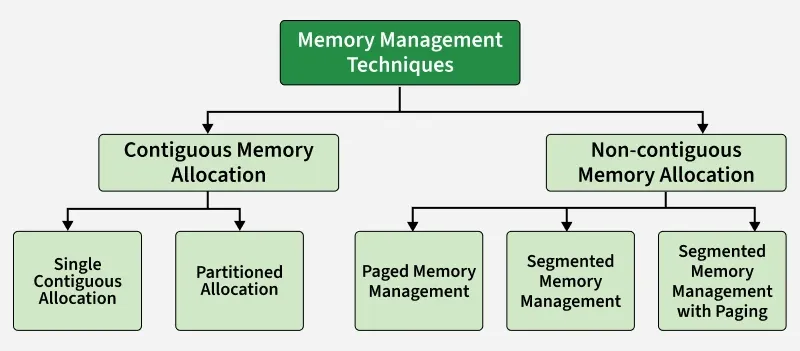
Memory allocation techniques are divided into two main types:
- Contiguous Memory Allocation
- Non-Contiguous Memory Allocation
Contiguous Memory Allocation
In contiguous memory allocation, each process is allocated a single continuous block of memory.
Types of Contiguous Allocation
- Fixed Partitioning
- Variable Partitioning
Fixed Partitioning Variable Partitioning Memory divided into fixed size partitions Memory divided dynamically Internal fragmentation occurs External fragmentation occurs Simple to implement Better memory utilization Fragmentation
Fragmentation occurs when memory is wasted due to memory allocation methods.
Types of Fragmentation
- Internal Fragmentation
- External Fragmentation
Internal Fragmentation External Fragmentation Unused memory inside allocated block Free memory available but not contiguous Occurs in fixed partitioning Occurs in variable partitioning Non-Contiguous Memory Allocation
In non-contiguous memory allocation, a process is divided into different parts and stored in different memory locations.
Types
- Paging
- Segmentation
 Paging
Paging is a memory management technique where logical memory is divided into pages and physical memory is divided into frames. A page table is used to map logical addresses to physical addresses.
Paging Description Page Block of logical memory Frame Block of physical memory Page Table Maps pages to frames Segmentation
Segmentation divides memory into segments based on program structure such as code segment, stack segment, and data segment.
Segmentation Description Segment Logical unit of program Segment Table Maps segments to memory Variable Size Segments are not fixed size Virtual Memory
Virtual memory allows programs to run even if they are larger than physical memory by using disk space as additional memory.
Virtual Memory Description Uses Disk Uses secondary memory Demand Paging Loads pages when needed Large Programs Programs larger than RAM can run Memory Allocation Algorithms
Operating system uses different algorithms for memory allocation:
- First Fit
- Best Fit
- Worst Fit
- Next Fit
Algorithm Description First Fit Allocates first available memory block Best Fit Allocates smallest suitable block Worst Fit Allocates largest block Next Fit Search starts from last allocated block Conclusion
Memory management is a core concept in operating systems. It helps in efficient memory utilization, process management, and system performance. Techniques like paging, segmentation, virtual memory, and memory allocation algorithms are used to manage memory efficiently.
🎓 Need Help With Your Project?
AcadKits provides ready-made engineering projects, custom development services, and free developer tools for students.
📚 Related Articles
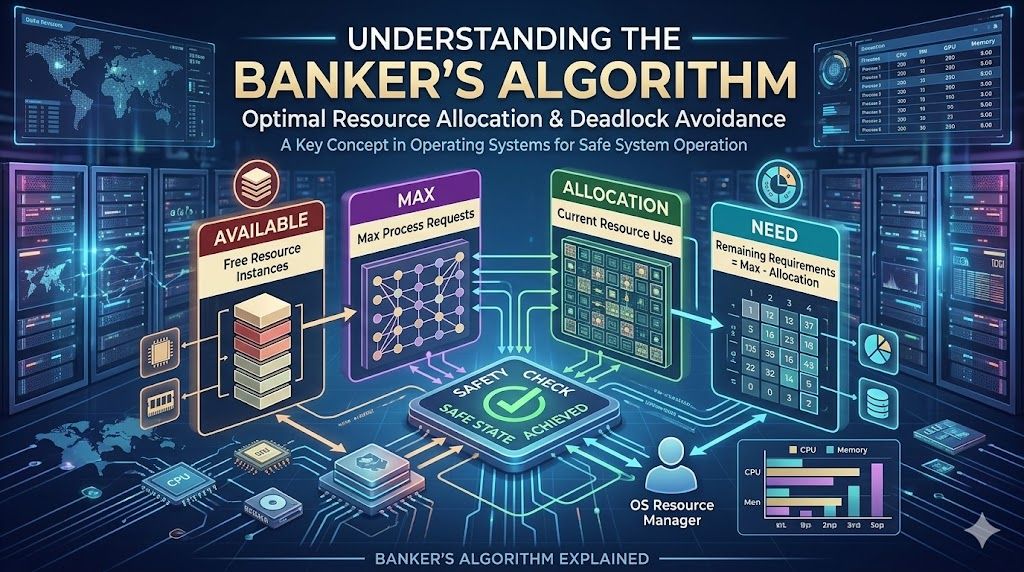
Banker's Algorithm in OS: How Operating Systems Avoid Deadlock
A deep-dive into the Banker's Algorithm — one of the most important deadlock avoidance techniques used in Operating Systems — explained with real examples, safety checks, and resource allocation tables.
⏱️ 10 min read
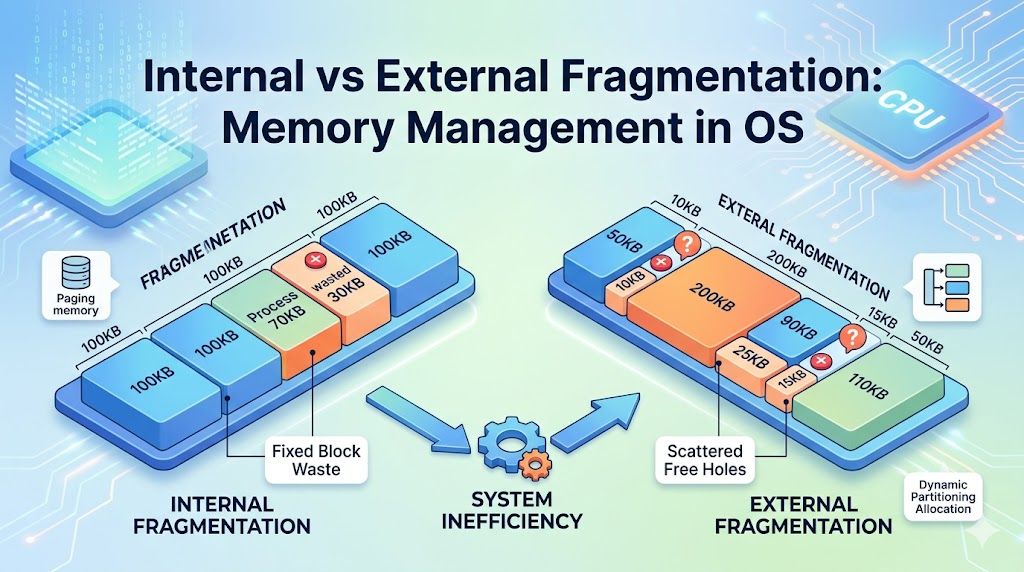
Internal vs. External Fragmentation: Key Differences & Solutions in OS
Learn internal vs external fragmentation in OS with simple examples, diagrams, and fixes like paging & compaction. Easy guide for students & devs!
⏱️ 2 min read